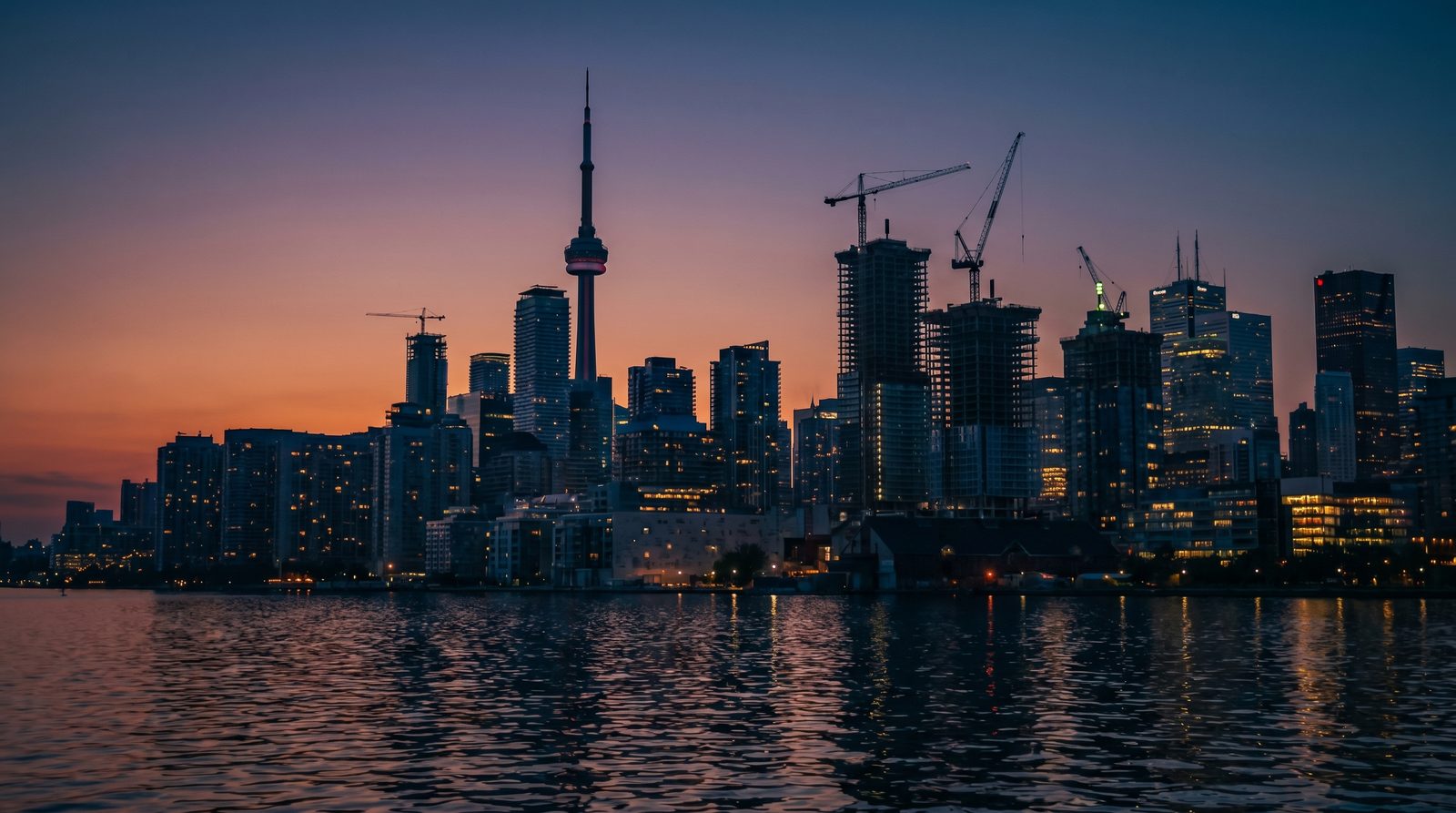
Approved-but-unbuilt: how Toronto development applications can block your lake view
Toronto has dozens of approved waterfront towers that haven't broken ground yet. Any unit currently showing an unobstructed lake view can permanently lose that view to a tower approved within its sightline. Before buying any view-dependent unit, check Toronto's Development Application Information Centre for every lot within 200 metres. This takes 5 minutes and prevents six-figure mistakes.
The invisible risk
A 2026 Toronto waterfront condo with a stunning lake view can become a condo with a concrete wall view by 2029 if a neighbouring tower was approved before you bought. The unit's current state reflects what's built today. The approved-but-unbuilt inventory determines what the view will be in 3-5 years.
This information is fully public. It's also routinely ignored.
Toronto's Development Application Information Centre
The city publishes every development application — active, approved, under construction — at toronto.ca's Development Application Information Centre (known as DAIC, or simply the Development Application map).
You can search by address, draw a radius, or browse by ward. Every marker shows:
- The proposed use (residential, commercial, mixed)
- The proposed height (number of storeys)
- The application stage (pre-application, under review, approved, at appeal, under construction)
- Documents associated with the file
This is the single most important pre-purchase check for any view-dependent condo.
The 200-metre rule
Within 200 metres of any Toronto condo unit, a new tower can materially affect:
- Direct lake/city view
- Sunlight hours
- Noise and street activity
- Building privacy (window-to-window distance)
Beyond 200 metres, impacts diminish quickly. Beyond 500 metres, effects are usually negligible.
So the check is: is there an approved tower within 200 metres of your target unit's sightline? If yes, model what that tower will do to the unit's value.
How to run the check in 5 minutes
1. Go to Toronto's Development Application Information Centre (search "Toronto development application map" if you can't find it directly)
2. Search for the unit's address
3. Use the map's radius tool (usually a ruler icon) to draw a 200-metre circle around the building
4. Click every marker within the circle
5. Note: proposed height, direction from the unit, application stage
If any approved application within the circle is tall enough to block the unit's current view, the view has an expiry date.
What counts as "approved"?
Development applications in Toronto move through stages:
- Pre-application: informal discussion, not yet committed. Low risk today.
- Application submitted: formal submission, in review. Moderate risk — some applications are rejected or substantially modified.
- Approved: zoning and site plan approved. High risk — the tower is legally able to be built.
- Under construction: cranes in the air. Imminent impact.
- Complete: already changed the context.
For buyers, "approved" is the meaningful threshold. Once approved, the tower can legally proceed. Cancellation is possible but uncommon.
The typical Toronto waterfront example
A lake-facing 2-bed in a 2005-built Harbourfront tower, south orientation, floor 14. Current view: open water, unobstructed.
Check the Development Application map around the unit:
- A 52-storey approved tower 180 metres southwest, under construction
- A 48-storey approved tower 150 metres southeast, approved but not yet construction
- An 8-storey mixed-use 100 metres west, no view impact
Impact analysis: the 52-storey southwest tower will block roughly 40% of the current view within 18-24 months. The 48-storey southeast tower will block another 30-40% within 3-4 years. The unit will go from "unobstructed lake view" to "partial view between two towers" by 2028.
Value impact: expect 15-25% reduction in resale value once both towers complete. An $1,100,000 unit today might trade at $850,000 once context changes.
How the Watchlist handles this
Every unit considered for the Watchlist goes through a Development Application check at purchase time. Units with view-blocking approvals within 5 years are excluded from the list regardless of other merits. Units where approved development would modify but not destroy the view are either excluded or flagged with the context.
This is one of the most time-consuming parts of the Watchlist curation. It's also one of the most valuable.
FAQ
How do I access Toronto's development application database?
Search 'Toronto development application map' or 'Application Information Centre Toronto' — the city publishes an interactive map at toronto.ca showing all active and approved applications with radius-search tools.
How often does an approved Toronto development get cancelled or substantially changed?
Cancellation of an approved application is uncommon but happens — usually due to developer financing issues or major market shifts. Substantial changes (height reductions, setback adjustments) happen more frequently. For buyer decisions, treat 'approved' as 'going to happen' with a small discount for uncertainty.
What's the distance at which a new tower affects my view?
Within 200 metres: significant impact possible. 200-500 metres: moderate impact depending on tower height and orientation. Beyond 500 metres: generally negligible view impact, though noise and density can still matter.
Does a Toronto condo's listing have to disclose nearby approved developments?
No. There is no legal requirement for a listing to disclose nearby approved developments that haven't broken ground. The information is public but not pushed to buyers. Buyer diligence is required.
Can I sue if my view gets blocked after I buy?
Almost never successfully. If the approval was public at time of purchase, you had constructive notice. If the developer started construction after your purchase, the original approval still predates you. Toronto's view-blocking litigation rarely succeeds.
Emma Pace, REAL Brokerage — Toronto waterfront condo specialist.